
As industries move toward smart manufacturing and connected systems, Industry 4.0 architecture has become the foundation of modern operations. It brings together machines, sensors, software, and cloud platforms to enable real-time data exchange and intelligent decision-making.
Read moreHow Industrial Gateways Extend the Life of Legacy Modbus Devices
How Industrial Gateways Solve the Problem
Many industrial facilities still rely on legacy Modbus devices for monitoring and control. These devices are reliable, stable, and often deeply integrated into existing infrastructure. However, modern building management systems, IoT platforms, and cloud applications typically require newer communication protocols such as MQTT, REST APIs, or BACnet.
Read moreDashboards vs Alerts: What Actually Prevents Downtime?
Machine Downtime Monitoring
Modern facilities generate a massive amount of operational data through building management systems (BMS), industrial controllers, and IoT devices. Protocols like BACnet and Modbus continuously collect data from HVAC systems, power meters, sensors, and other critical equipment.
Read moreUse Cases: How BACnet & Modbus to MQTT, SMS, and API Improves Facility Management
Modern facilities rely on systems like HVAC, lighting, energy meters, pumps, and security equipment. Many of these systems communicate using BACnet and Modbus, which are widely used in building automation. However, these protocols often remain limited to Building Management Systems (BMS), making it difficult to integrate them with modern IoT platforms, cloud services, and alert systems.
By bridging BACnet and Modbus to MQTT, SMS notifications, and REST APIs, facility managers can unlock real-time monitoring, automation, and better operational visibility.
1. Real-Time Monitoring and IoT Integration
Building systems generate valuable data but accessing it outside the BMS (Building Management system) can be challenging. Converting BACnet or Modbus data into MQTT streams or APIs allows seamless integration with IoT platforms and cloud dashboards.
For example, HVAC temperature, energy usage, or occupancy data can be published to MQTT and monitored remotely across multiple sites. This helps facility teams track performance and identify issues faster.
2. Smart Alerts and SMS Notifications
Traditional BMS alarms often remain within BMS (Building Management system), meaning problems may go unnoticed until someone checks the dashboard.
With BACnet or Modbus connected to SMS alert systems, critical events can trigger instant notifications. Escalation logic ensures the right person receives the alert at the right time.
For example, if a pump stops working or a chiller temperature exceeds limits, an SMS alert can notify the maintenance team immediately, reducing downtime and operational risk.
3. Integration with Enterprise Applications via APIs
Many organizations rely on external systems such as CMMS platforms, energy management tools, or facility dashboards. However, BACnet and Modbus devices cannot directly communicate with these applications.
By converting building data into REST APIs, facility managers can integrate systems with:
- Maintenance management platforms
- Energy analytics tools
- Smart building dashboards
- Enterprise monitoring systems
This enables automation, such as automatically creating a maintenance ticket when equipment performance drops.
4. Predictive Maintenance and Data Analytics
When BACnet and Modbus data is continuously streamed to analytics platforms, facility teams can shift from reactive to predictive maintenance.
Monitoring parameters such as temperature, vibration, or energy usage helps detect early warning signs of equipment issues. This allows maintenance teams to address problems before failures occur, improving reliability and reducing costs.
5. Connecting Legacy Systems to Smart Buildings
Replacing existing building infrastructure can be costly and disruptive. Protocol conversion provides a simpler way to modernize facilities.
By bridging legacy BACnet and Modbus devices to MQTT and APIs, organizations can connect older systems to modern IoT platforms without replacing existing equipment.
BACnet & Modbus to MQTT Gateway – Conclusion
Integrating BACnet and Modbus to MQTT Gateway, SMS alerts, and REST APIs helps transform traditional building systems into connected, intelligent infrastructure. Facility managers gain better visibility, faster alerts, and improved integration with modern software platforms.
Solutions like ProtoConvert make it easier to bridge legacy building protocols with modern technologies—helping organizations build smarter and more efficient facilities.
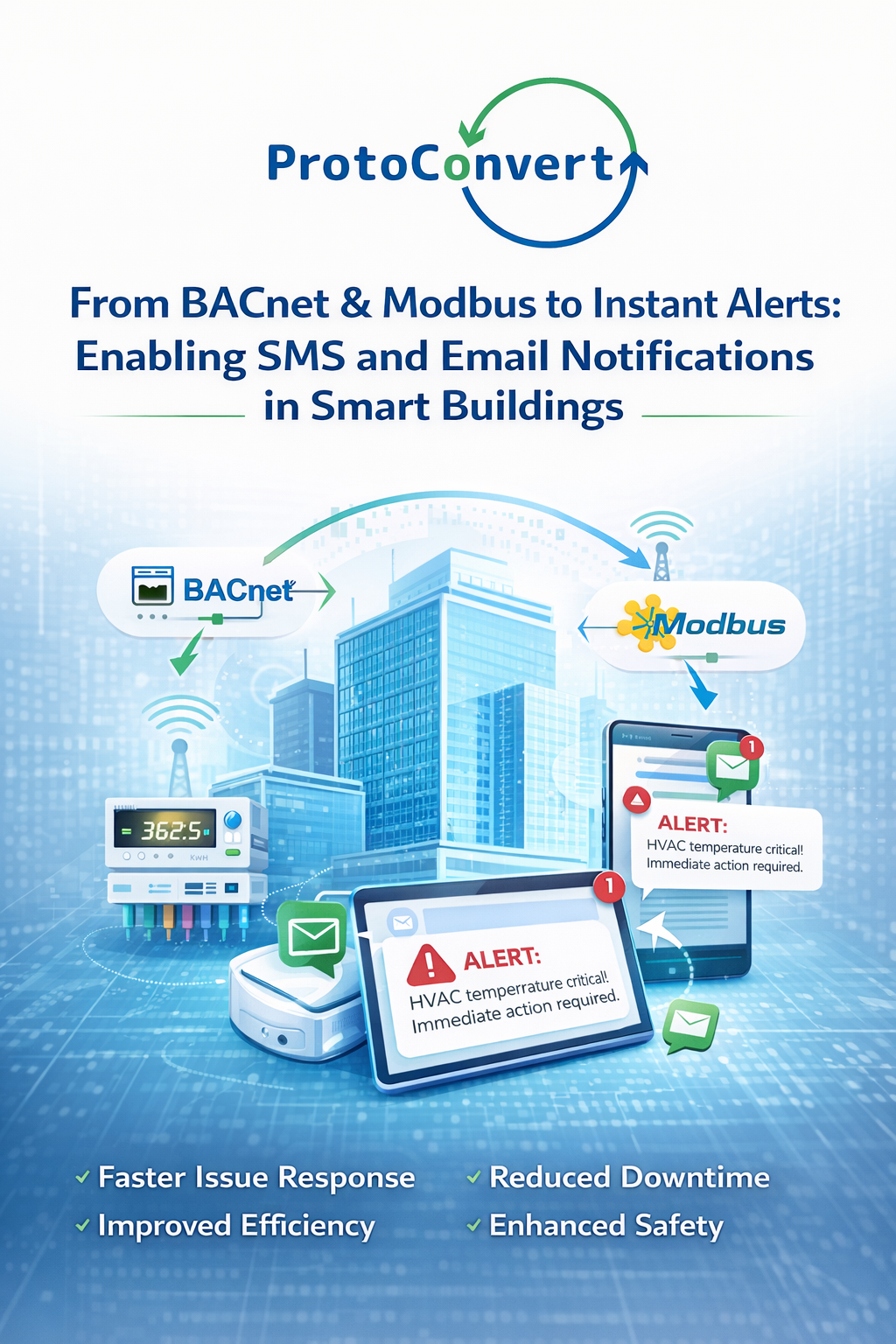
From BACnet & Modbus to Instant Alerts: Enabling SMS and Email Notifications in Smart Buildings
Modern smart buildings generate massive amounts of data through systems like HVAC, energy meters, sensors, and controllers. These devices typically communicate using protocols such as BACnet and Modbus, allowing Building Management Systems (BMS) to monitor operations in real time.
However, simply collecting data is not enough. What truly matters is ensuring that critical events reach the right people immediately. This is where BACnet & Modbus alerts, along with SMS and email notifications, play a vital role.
Turning Building Data into Action
BACnet and Modbus allow building systems to share operational data such as temperature, energy consumption, equipment status, and alarms. By integrating these protocols with intelligent alerting systems, facilities can automatically monitor key parameters and trigger notifications.
For example, BACnet and Modbus alerts can be sent when:
- HVAC temperature exceeds set limits
- Detect abnormal consumption in power meters
- Equipment outage
- Sensors detect leaks or failures
Instead of waiting for someone to check a dashboard, alerts are delivered instantly via SMS or email, enabling faster response.
BACnet & Modbus alerts – Smart Alerting Features
Modern alerting solutions do more than just send alarms. They add intelligence to ensure notifications are useful and actionable.
Smart filtering ensures only meaningful alarms are sent, reducing unnecessary alerts.
Escalation logic allows notifications to move up the chain if the first person does not respond.
Multi-channel delivery ensures alerts reach teams through SMS, email, or monitoring dashboards.
This helps avoid alarm fatigue while ensuring critical issues are never missed.
Benefits for Smart Buildings
Implementing instant alerts offers several advantages:
- Faster response to system faults
- Reduced equipment downtime
- Improved energy monitoring
- Better operational efficiency
- Enhanced building safety
By converting protocol data into actionable notifications, facility teams can move from reactive monitoring to proactive management.
Conclusion
BACnet and Modbus form the backbone of modern building automation, but their real value comes from transforming data into timely action. By enabling automated SMS and email alerts, smart buildings can ensure that critical information reaches the right people instantly — helping teams respond faster, reduce risks, and keep operations running smoothly.
How Automation Eases Your Maintenance Tasks
Automated maintenance management system
Maintenance plays a critical role in ensuring the reliability, safety, and efficiency of buildings and industrial facilities. However, traditional maintenance approaches are often time-consuming, reactive, and heavily dependent on manual inspections. This is where automation transforms the way maintenance tasks are managed.
Read moreWhat Is VDGS?
Modern airports rely heavily on automation to ensure safe, efficient, and standardised aircraft operations. One such critical technology is VDGS, commonly used at airport gates to guide pilots during aircraft docking. As airports continue to expand and modernise, understanding what VDGS is and how it integrates with other airport systems becomes increasingly important.
Read moreBACnet Integration for Building Automation Systems
BACnet (Building Automation and Control Networks) is one of the most widely used communication protocols in building automation systems. It enables devices from different manufacturers, such as HVAC controllers, energy meters, fire panels, and lighting systems, to communicate seamlessly. At the core of this communication are BACnet objects, which represent real-world data and control points.
2026 IoT Predictions: Key Trends Shaping the Future of Connected Systems
The Internet of Things (IoT) continues to transform industrial automation, smart buildings, and infrastructure worldwide. As we move toward 2026, IoT is evolving from basic connectivity to intelligent, secure, and interoperable systems. Businesses that align with upcoming IoT trends and predictions for 2026 will be better positioned to scale, optimize operations, and stay competitive.
Read more