
How Industrial Gateways Solve the Problem
Many industrial facilities still rely on legacy Modbus devices for monitoring and control. These devices are reliable, stable, and often deeply integrated into existing infrastructure. However, modern building management systems, IoT platforms, and cloud applications typically require newer communication protocols such as MQTT, REST APIs, or BACnet.
Replacing all legacy devices can be expensive and disruptive. This is where industrial gateways play a critical role.
Industrial gateways act as translators between older Modbus equipment and modern digital platforms, allowing organizations to extend the life of their existing assets while adopting new technologies.
The Challenge with Legacy Modbus Systems
Modbus has been one of the most widely used communication protocols in industrial automation for decades. While it is dependable and simple, traditional Modbus systems often face several limitations:
- Limited compatibility with modern IoT platforms
- Lack of native cloud connectivity
- No built-in remote monitoring capabilities
- Difficult integration with modern building management systems
As facilities evolve toward smart infrastructure and data-driven operations, these limitations become more noticeable.
How Industrial Gateways Solve the Problem
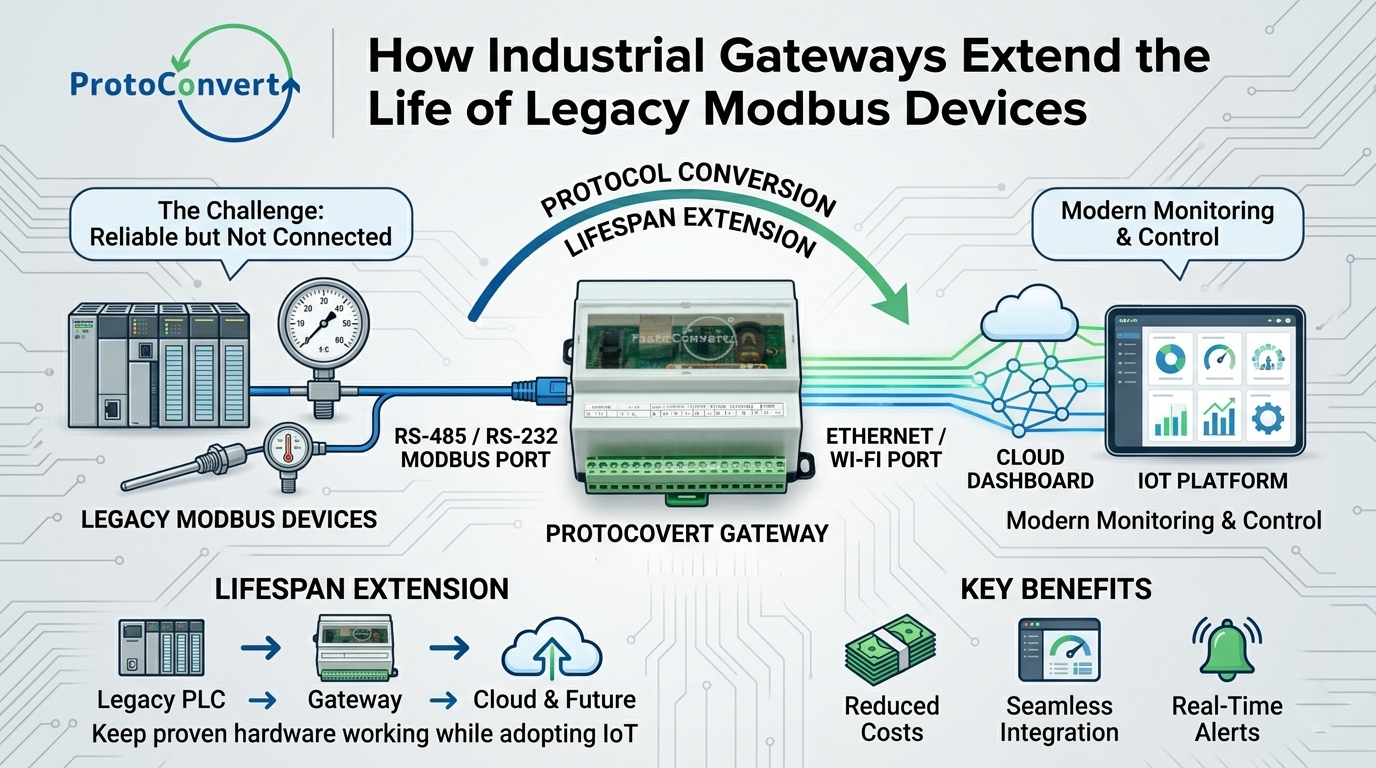
Industrial gateways bridge the communication gap between legacy devices and modern systems. Instead of replacing working equipment, organizations can install a gateway that converts Modbus data into newer protocols.
This enables seamless communication between legacy devices and advanced platforms.
Typical protocol conversions include:
- Modbus to MQTT for IoT cloud platforms
- Modbus to REST API for software integrations
- Modbus to BACnet for building automation systems
- Modbus to SMS or alerts for instant notifications
With a gateway in place, data from older equipment becomes accessible to modern monitoring and analytics tools.
Key Benefits of Using Industrial Gateways
1. Extending Equipment Lifespan
Industrial equipment can remain operational for many years. Instead of replacing functioning Modbus devices, gateways allow them to continue working while still integrating with modern systems.
This significantly extends the lifecycle of existing infrastructure.
2. Lower Upgrade Costs
Replacing hundreds of sensors, controllers, and meters across a facility can be costly. Industrial gateways eliminate the need for large-scale hardware replacement, making modernization more affordable.
3. Easy Integration with Modern Platforms
Gateways enable legacy Modbus devices to connect with:
- IoT dashboards
- cloud monitoring systems
- facility management platforms
- analytics software
This allows businesses to extract more value from their existing data.
4. Real-Time Monitoring and Alerts
Modern gateways can send alerts through SMS, dashboards, or APIs when critical parameters cross predefined thresholds.
This helps teams identify issues early and prevent costly downtime.
5. Simplified System Expansion
As facilities grow, new devices and systems can be added without replacing legacy infrastructure. The gateway acts as the central communication bridge.
Real-World Use Cases
Industrial gateways are widely used across various industries:
Manufacturing Plants
Legacy Modbus PLCs and sensors can send production data to cloud dashboards for monitoring and analytics.
Commercial Buildings
Energy meters and HVAC controllers using Modbus can integrate with BACnet building management systems.
Energy Monitoring Systems
Power meters connected via Modbus can transmit data to IoT platforms for energy optimization.
Remote Facilities
Gateways can push alerts via SMS or APIs when equipment faults occur.
Future-Proofing Industrial Infrastructure
Digital transformation does not always require replacing existing equipment. By using industrial gateways, organizations can modernize their systems while preserving reliable legacy devices.
This approach allows facilities to adopt IoT technologies, improve monitoring, and enhance operational efficiency without major disruptions.
Conclusion
Legacy Modbus devices continue to power many industrial systems worldwide. Instead of replacing these dependable assets, industrial gateways provide a smart path toward modernization.
By enabling protocol conversion, real-time monitoring, and cloud connectivity, gateways help organizations extend the life of their equipment while unlocking the benefits of modern digital infrastructure.
For facilities looking to upgrade their systems without costly replacements, industrial gateways offer a practical and future-ready solution.