
Building Management Systems (BMS) have evolved far beyond basic monitoring and control. Today, the combination of Artificial Intelligence (AI) and the Internet of Things (IoT) is transforming buildings into intelligent, connected ecosystems. From real-time monitoring to predictive maintenance and energy optimization, AI and IoT help facility managers improve operational efficiency while reducing costs.
Real-Time Data Collection with IoT
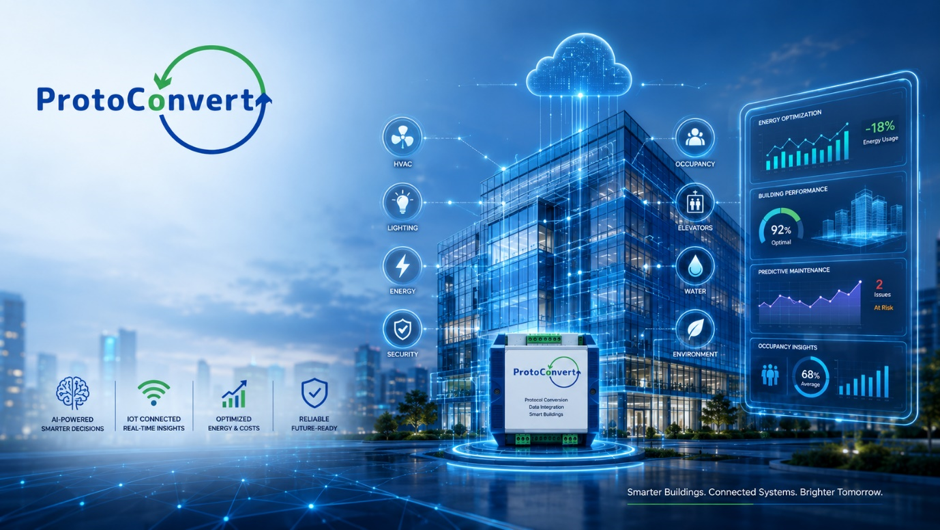
IoT devices continuously collect data from HVAC systems, lighting, energy meters, security systems, elevators, and environmental sensors. This real-time information provides facility managers with complete visibility into building performance, enabling faster decision-making and proactive management of building assets.
AI Enables Smarter Building Operations
AI analyzes the information gathered by IoT devices to identify patterns, detect anomalies, and automate routine decisions.
For example, AI can:
- Optimize HVAC performance based on occupancy.
- Detect abnormal equipment behaviour.
- Improve occupant comfort while minimizing energy usage.
Predictive Maintenance Reduces Downtime
AI-powered predictive maintenance identifies early warning signs such as unusual temperature, vibration, or energy consumption. Maintenance teams receive alerts before failures occur, reducing unexpected downtime, extending equipment lifespan, and lowering maintenance costs.
How ProtoConvert Australia Supports Smart Buildings
ProtoConvert Australia provides industrial protocol gateways that enable seamless communication between building automation devices using protocols such as BACnet, Modbus, MQTT, SNMP, OPC UA, and JSON. Our solutions connect legacy and modern equipment into a unified Building Management System, enabling efficient AI and IoT integration.
Conclusion
AI and IoT are transforming Building Management Systems through intelligent analytics, predictive maintenance, and energy optimization. With ProtoConvert Australia’s protocol conversion solutions, businesses can seamlessly integrate diverse systems and build smarter, more efficient, and future-ready buildings.